
Generating leads through Meta Ads is often the easy part. The more difficult question is whether those leads are actually valuable.
A person may submit a form because they are curious, but that does not necessarily mean they are ready to book an appointment, apply for a service or make a purchase. This is why a campaign reporting a low cost per lead can still produce disappointing business results.
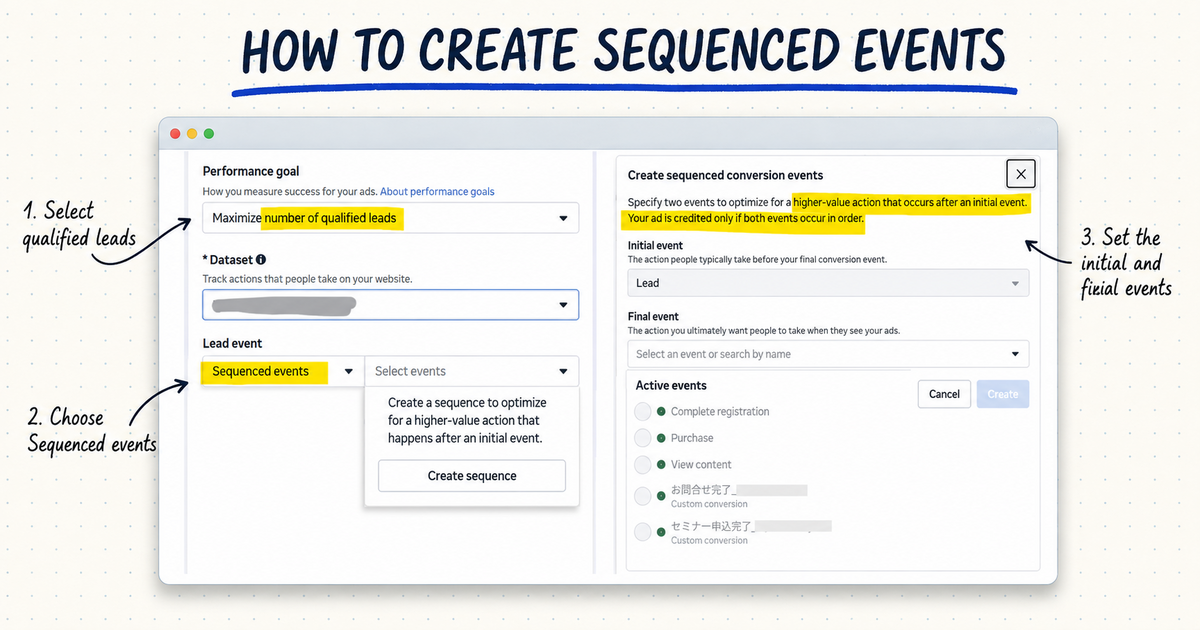
Meta appears to be addressing this problem through a new feature called Sequenced Events, connected with the Maximize number of qualified leads performance goal for Lead campaigns using instant forms.
This feature is new and has not yet been rolled out in my Ads Manager. Therefore, I have not tested the setup in a live campaign. I got to know about this information through LinkedIn shared by Dario Zannoni.
What are Sequenced Events?
As per my assumption, Sequenced Events allow an advertiser to define a qualified lead using two actions that must happen in a particular order.
The sequence is:
Lead event → Higher-value final event = Qualified lead
The first action shows that someone has become a lead. The second shows that the person later took an action indicating stronger intent or greater value.
Meta reportedly credits the qualified-lead result only when both selected events occur in the correct order. In other words, the person must first trigger the initial Lead event and then trigger the final event.
A form submission on its own can still be recorded as a lead. However, it would not complete the sequence required to be treated as a qualified lead.
Understanding the two events
1. Initial Event
The initial event will normally be the standard Lead event. It could be triggered when someone submits a form hosted on your website.
For example, a visitor may:
Request a consultation
Ask for a quotation
Submit an admission enquiry
Request more information
Register their interest in a service
This action tells Meta that the advertisement generated a lead. However, it does not yet tell Meta whether that person is a good lead.
2. Final Event
The final event represents a more valuable action taken after the original form submission.
Depending on the business, it might represent:
Booking an appointment
Completing a registration
Starting an application
Requesting a detailed quotation
Becoming eligible for a service
Reaching a particular stage in the CRM
What problem is Meta trying to solve?
Meta’s system normally optimizes delivery toward the event selected by the advertiser. If you ask it to maximize leads, it looks for people who are likely to complete the Lead event.
That can successfully increase form submissions, but it creates a familiar problem: Meta may find people who are good at becoming leads without finding people who are good at becoming customers.
Consider two campaigns:
- Campaign A generates 100 leads, but only five become serious prospects.
- Campaign B generates 50 leads, but 20 become serious prospects.
If we look only at the number or cost of leads, Campaign A may appear more successful. From a business perspective, Campaign B is producing much greater value.
Sequenced Events appear designed to give Meta a more meaningful success signal. The system is no longer being told only, “Find more people who submit this form.” It is being told, “Find more people who submit this form and then complete this valuable next action.”
The timing problem in lead generation
Lead-generation campaigns often have a delay between the first enquiry and the final business outcome.
A form submission may happen immediately after an advertisement click. Qualification may take several days, and a consultation, application or sale may happen even later.
For example:
Day 1: The person submits a form.
Day 3: The sales or counselling team makes contact.
Day 8: The person attends a meeting.
Day 15: The person begins an application or purchases the service.
This delay can make it difficult for an advertising system to connect a fast advertising interaction with a later business result.
Sequenced Events may help by combining the initial Lead event, which provides a relatively fast signal, with a later event that provides a stronger quality signal. Meta could then learn which initial leads are more likely to complete the second action.
The maximum time allowed between the two events is not yet clear. Advertisers should not assume a specific window until Meta confirms the timing rules in its documentation or inside the account setup.
Leads versus qualified leads
A lead is someone who has expressed interest. A qualified lead is someone who has also met a more meaningful condition defined by the business.
| Lead | Qualified lead |
|---|---|
| Submitted a website form | Submitted the form and completed the selected final action |
| May only be curious | Has demonstrated stronger intent |
| Provides an early signal | Provides an early signal plus a quality signal |
| Easier and faster to generate | Usually fewer in number but more valuable |
The definition of a qualified lead should reflect a real business outcome. An advertiser should not select an easy second action simply to report more qualified leads. The final event needs to distinguish genuine prospects from ordinary enquiries.
How is this different from Conversion Leads?
Meta’s existing public guidance describes Conversion Leads as a quality-focused performance goal, especially for Instant Forms. Under that approach, advertisers connect their CRM to Meta through Conversions API and return information about what happens to leads later in the sales process.
The process generally looks like this:
Meta lead → CRM receives lead → Sales team qualifies lead → CRM sends outcome back to Meta
This approach can be powerful, but it may require a properly configured CRM, Conversions API, reliable data matching and development support.
Sequenced Events appear to make the definition more explicit: an initial event followed by a selected final event. They may also allow website Standard Events and Custom Conversions to act as the final event in some configurations, instead of requiring every qualifying signal to originate from a CRM.
That does not mean a CRM is no longer useful. If the meaningful final action happens inside your CRM—for example, when a sales team marks someone as qualified—the CRM still needs to send that information back to Meta, normally through Conversions API.
It is best to think of Sequenced Events as a potentially more flexible way to describe and track the journey, rather than proof that CRM integration is no longer required.
How might Meta learn from the sequence?
Meta reportedly needs historical evidence that the final event occurs after the initial Lead event. The interface appears to assess qualifying sequences over a period of 28 days.
For example, imagine that 200 people trigger the Lead event and 40 of those same people later trigger the selected final event. Meta can study the completed sequences and look for patterns that separate those 40 people from leads who did not progress.
Over time, this information may help its delivery system find more people who are likely to complete the entire journey.
However, the exact minimum number of qualifying sequences has not been clearly confirmed. A business with very few final events may struggle to provide Meta with enough information for stable optimization.
What may be required to set it up?
The exact setup may vary, but advertisers are likely to need several foundations in place:
A Meta Pixel installed correctly on the website
A Meta Dataset connected to the correct ad account
The Lead event firing after a successful form submission
A reliable Standard Event, Custom Conversion or CRM event for the final action
Conversions API when server-side or CRM-based reporting is needed
Consistent identifiers that help Meta match the two events to the same person
Enough historical data showing completed sequences
Event testing inside Meta Events Manager
Tracking accuracy matters. If Meta cannot reliably connect the initial and final events to the same person, it may not recognize the sequence.
Two possible implementation models
1. Website-based sequence
Suppose a visitor first submits an enquiry form and later completes a separate registration on the website.
The advertiser might use:
Lead → CompleteRegistration
Both events happen on the website and can potentially be reported using the Pixel and Conversions API.
2. CRM-supported sequence
Suppose the final qualification decision happens after a member of the sales team reviews the lead.
The journey might be:
Lead → Qualified stage recorded in CRM
The CRM would need to send the later outcome back to Meta through Conversions API. This allows Meta to learn from business results that are not visible on the website.
How should you choose the final event?
The best final event is not necessarily the last step in your complete sales process. It should be a meaningful action that happens often enough to provide useful data.
Ask yourself:
- Does this action genuinely indicate higher lead quality?
- Does it normally happen after the Lead event?
- Can we track it consistently?
- Can Meta match it to the original lead?
- Does it happen frequently enough to support optimization?
For a consultancy, a booked and attended meeting may be more useful than a final sale if sales take several months and happen too infrequently. For another business, a completed registration or approved quotation request may be the most practical signal.
Limitations and unanswered questions
Because this is a new and developing feature, several important questions remain:
When will it become available to all eligible advertisers?
Which ad accounts and regions will receive it first?
Which Standard Events can be selected as final events?
Can every Custom Conversion be used?
What is the exact minimum number of completed sequences?
How much time can pass between the initial and final events?
How will reporting differ for ordinary leads and qualified leads?
Will the requirements differ between website forms and Instant Forms?
I have not yet found complete official Meta documentation that answers all of these questions. This is also why I would avoid making major tracking changes based only on early interface observations.
Final thoughts
Sequenced Events appear to represent an important change in how Meta defines and optimizes for lead quality.
Instead of treating every form submission as equally valuable, the system can potentially look for a two-step journey:
Lead submitted → Valuable next action completed
This gives advertisers a clearer way to tell Meta what a good lead actually looks like.
However, it is important to keep the current limitations in mind. The feature has not yet appeared in my Ads Manager, so I cannot share a practical campaign setup or first-hand performance results at this stage. This article reflects my understanding of the developing feature based on the available information. I will update it when the feature becomes available to me and Meta publishes clearer guidance about its eligibility, timing and data requirements.
For now, the best preparation is to improve your event tracking, define what a qualified lead means for your business and make sure your website or CRM can reliably record the actions that matter after a form is submitted.
Frequently asked questions
Is every form submission a qualified lead?
No. A form submission triggers the initial Lead event. Under the Sequenced Events model, the same person would also need to complete the selected final event to satisfy the qualified-lead sequence.
Do I need a CRM to use Sequenced Events?
Possibly not in every setup. If both actions can be recorded reliably on your website, a website event or Custom Conversion may be sufficient. If qualification happens inside your CRM, you will need to send the outcome from the CRM to Meta.
Do I need Conversions API?
Conversions API is recommended for more reliable server-side reporting and is normally necessary when sending CRM outcomes to Meta. The exact requirement will depend on your event sources and the options available in your account.
How many sequences does Meta need?
Meta appears to require enough historical completed sequences during a 28-day period, but the exact minimum volume has not yet been clearly documented. Do not assume a number until Meta confirms it.
How long can pass between the two events?
The maximum permitted delay between the Lead event and final event remains unclear. This should be confirmed through official documentation or the instructions shown in your Ads Manager when the feature becomes available.